
Football is a complex sport as although is it predominantly an aerobic game, the anaerobic elements that accompany it are highly important within match-play (Sporis, Jukic, Ostojic & Milanovic, 2009). The average intensity of a 95-100 minute game usually lie at 75% VO2Max or 85% HRMax (Al’Hazzaa, Almuzaini, Al-Refaee & Sulaiman, 2001).
Ensuring your training sessions are both adequate and challenging for your players needs is difficult, even more so when you have a squad of over 20 players! How you go about prescribing training whilst ensuring individual needs of players are accounted for is even more of a challenge! So here are some helpful tips which may help you ranging from scientific tests to simply using a Rating of Perceived Exertion Scale!
VO2Max Test and Lactate Profiling
These laboratory tests require each individual player to perform an incremental maximal exercise protocol usually on a treadmill. During this time various measures of oxygen uptake and blood samples will be taken. Upon completion of the test the sport scientist would be able to present to you a graph similar to the one you see below, outlining target zones which can then be used to prescribe different types of endurance-based training.

Pros
- Valid and reliable scientific measure
- When done together can generate accurate training zones allowing training prescriptions
Cons
- Requires laboratory facilities with expensive equipment and sports science staff
- Some research questions its validity in team sports
- Cheaper alternatives can give you the information you need
Scores: Scientific 5/5 Practicality 1/5
Overall Score: 6/10
Rating of Perceived Exertion
You may or may not be familiar with an RPE scale but in simple terms this is just a numbered scale of how hard your players found a training session. This can be used as a cheap monitoring tool to assess your players for injury risk but also as a way to prescribe your training sessions. Through research practitioners have been able to predict at which RPE values the critical lactate threshold lie. This means you can use RPE to prescribe your training intensities without the need of all the fancy laboratory tests or equipment! Take a look at the table below to see how it would work.
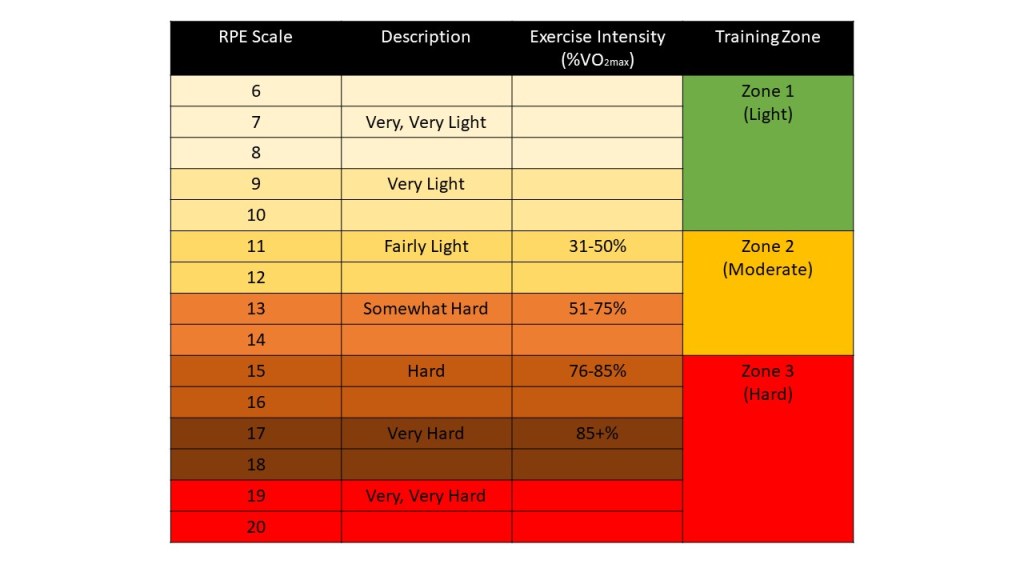
(Ritchie, 2012)
Pros
- Cheap, quick and easy
- Enables you as a coach to prescribe different training intensities based on the context
- Can be done in the field (or anywhere you wish!)
Cons
- Lacks reliability compared to laboratory tests
- Relies on players honesty and engagement with understanding the scale
Scores: Scientific 3/5 Practicality 5/5
Overall Score: 8/10
Heart Rate
With all the new fitness watches and other technology heart rate has never been so easy to collect, but have you ever thought of using it to help prescribe your training? By simply prescribing a heart rate to work at during a session allows you to have control over which training zone the player is working in to elicit your desired adaptations. Firstly, calculate Age Predicted Maximum Heart Rate (220-age) and then try using the table below on your players to see between which heart rate values would be needed during the session to hit each training zone.
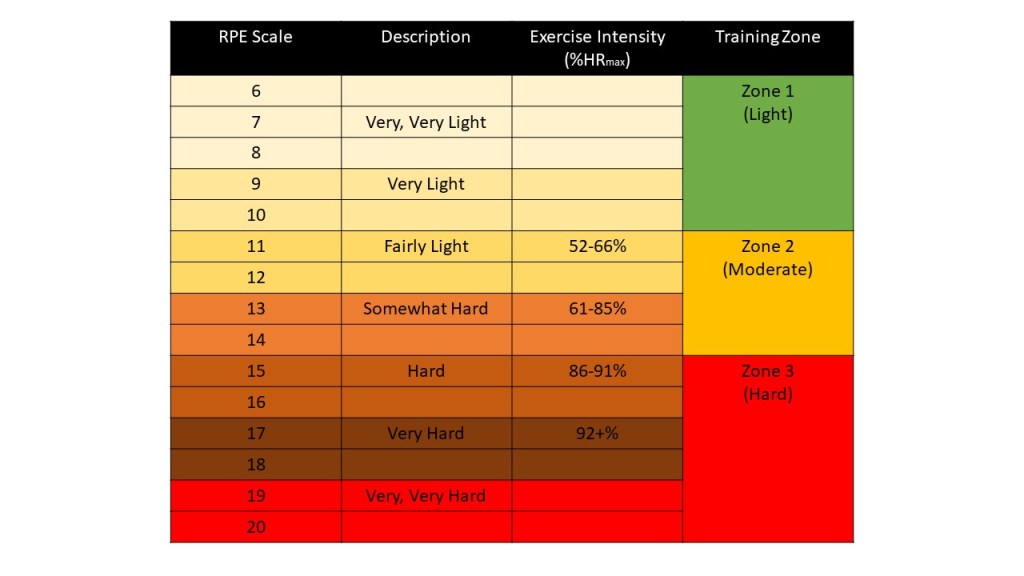
(Achten & Jeukendrup, 2003)
Pros
- Data is easily accessible and very informative
- Can be done in the field (or anywhere you wish!)
Cons
- Requires heart rate monitors/watches to be sure of exercise intensity unless using RPE
- Heart rate monitors can be inaccurate and unreliably
Scores: Scientific 3/5 Practicality 4/5
Overall Score: 7/10
 Football Science