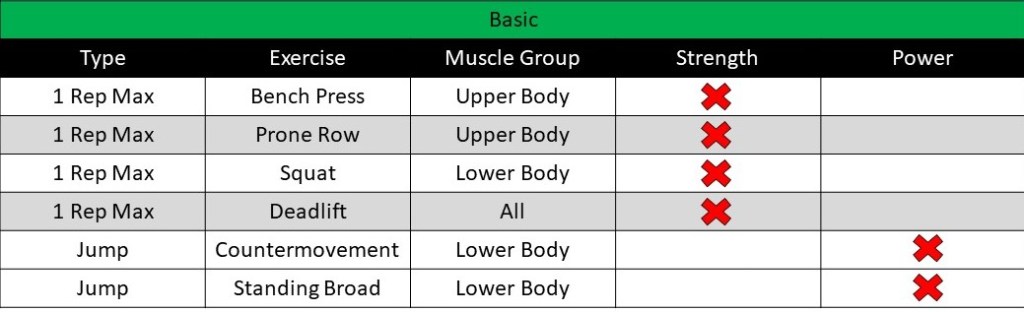
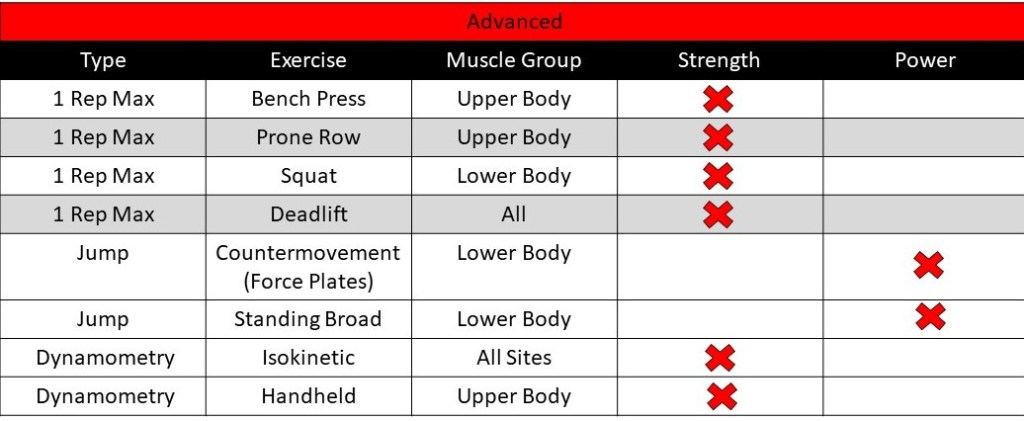
Due to the need for repeated powerful movements such as kicking, sprinting and jumping with soccer the need for strength and power within your players is obvious (Turner et al., 2011). Throughout the season and as your players strength and power increases through training it is important to monitor this through testing (Peterson, Alvar & Rhea, 2006; Paul & Nassis, 2015). This will not only highlight any potential injury risks of your players but also allow you to adapt gym-based programmes based on improvements of the players (Turner et al., 2011). Whether you have a fully equipped fitness suite or limited facilities there will be to a way to test your players strength and power!
Why not take a look at the testing ideas below, either the basic or advanced section, depending on your resources!
Top Tips to Perform a 1 Rep Max Test
General
- Ensure your players are familiar with the technique of the lifts you want to acquire a 1 Rep Max for, failure to do this could resort in serious injury leaving players out for weeks or even months!
- Ensure adequate space and time is available to carry out the tests in a safe and controlled manner, DO NOT rush as this is when mistakes and injuries occur.
- Check all equipment prior to starting the tests, ensure it is in working order to limit injury risk.
Procedure
- For each test ensure 3 people are present as well as the player being tested (two spotters and you as the coach recording weights).
- Spotters should be located at either end of the barbell and should only intervene if the player can no longer safely move the weight.
- Ensure all players follow a safe warm up procedure, DO NOT go straight into weights near or close to 1 Rep Max! (begin around 50-60% of 1RM, performing 2-3 reps)
- If you have previous 1 Rep Max scores use these to calculate weights to progress them slowly to perform a 1 Rep Max.
- Ensure rest periods of 3-5 minutes between near maximum lifts to ensure full recovery from each lift and to allow players the best chance to achieving new personal bests.
- Only record scores and grant a 1 Rep Max if the repetition is completed unaided, with good technique.
Follow Up
- Ensure players are given adequate rest and have a look at the nutritional recommendations on the nutrition tab to see how that can aid recovering (Protein will be key!)
- Keep records of all 1 Rep Max testing that you perform as a team, this can not only be used a strength monitoring tool but also identify potential injury risks, used as a training prescription tool and also provide good competition between players to improve motivation within gym sessions.
Maximal vs Sub-maximal Tests
Maximal tests are ones that require maximal effort usually for a short period of time or 1 repetition, hence the name! Sub-maximal tests are ones that require slightly less effort but usually over a longer period or larger number of repetitions. Although any type of fitness testing is beneficial within football especially arguments can be made for both types of testing methods.
Maximal testing is often seen as the ‘go to’ testing method within coaches as it is the mostly commonly known and relatively simple to complete. Within football performing maximal tests such as 1 Rep Max or VO2 Max allows many variables to be collect and from that training prescriptions and injury risks can be identified (Impellizzeri, Rampinini & Marcora, 2005). However, questions over its application to football can be discovered as how often in football do players perform one sole maximal effort with a period of rest following each bout? Is football not more about performing regular near maximal bouts with varied rest periods? If so, surely submaximal tests may be more useful to you as coaches? Nevertheless, it is important to highlight that maximal tests are beneficial in tracking numerous fitness indicators such as aerobic fitness and aerobic power/strength. However due to the need for specialist equipment and facilities it can be difficult for football clubs to gain access to the tests, meaning if this is done at the beginning and end of every season for tracking purposes with more accessible and applicable sub-maximal testing in between coaches like yourself should form a good fitness tracking monitoring system.
Sub-maximal tests are becoming more prevalent, especially within soccer in Italy. Coaches have been using adapted versions of tests to move towards a sub-maximal testing protocol. Most of the tests focus on aerobic fitness and have become commonly used due to the affordability and practicality of the tests [20 mins to test 1 player] (Impellizzeri, Mognoni, Sassi & Rampinini, 2005). It is also important to highlight along with submaximal tests being more replicable to soccer, your players will also buy into this process of testing as they don’t have to work as hard! Performing maximal tests is not a nice experience, with submaximal tests although the players may be working for slightly longer most prefer the lower requirement of effort needed to perform the tests.
Overall, it is up to you as coaches to assess your players and the availability you have to test them. From a sports science view any testing protocol is better than not testing at all, however when you take time to assess the best options your testing protocol will improve. By mixing maximal and sub-maximal tests at different stages of the season allows you to build a good fitness profile for each player and from that can form the basis of training sessions for the season.
 Football Science